Research Peptide Products Online: 11 Essential Factors for Smarter Laboratory Procurement
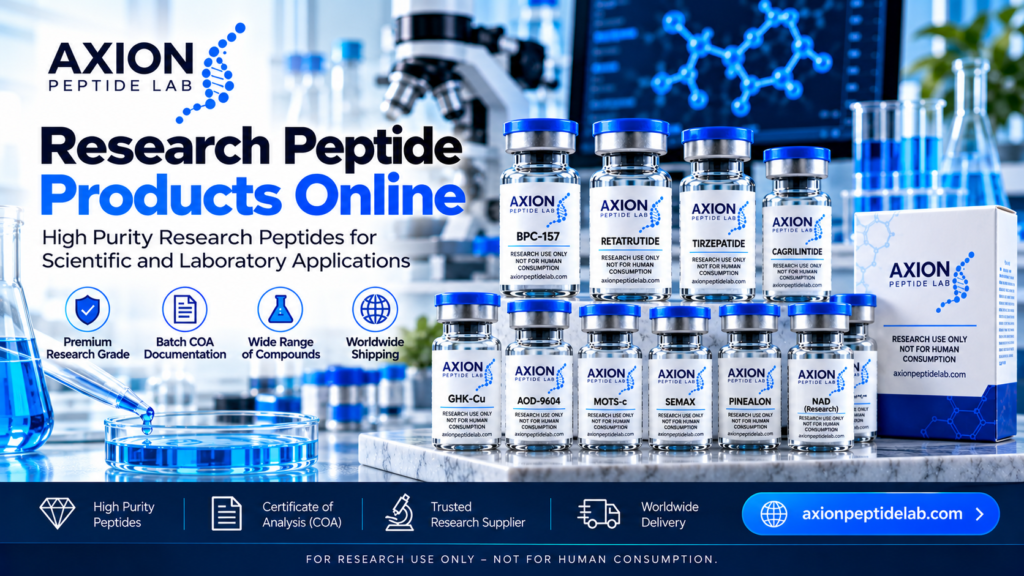
Finding reliable research peptide products online requires more than browsing a catalogue and comparing prices. Researchers should consider compound identity, stated purity, analytical documentation, batch traceability, storage requirements, product format, supplier transparency, shipping conditions, and the specific requirements of their experimental work. research peptide products online
The growth of peptide science has created significant interest in research materials for biochemical, molecular, analytical, and laboratory investigation. At the same time, the number of products and suppliers available online means researchers have more information to evaluate before making procurement decisions.
A professional research catalogue should make it straightforward to understand what a product is, the quantity supplied, its intended purpose, and any available supporting information.
This comprehensive guide explains what researchers should consider when evaluating research peptide materials online, how documentation fits into laboratory procurement, why batch identification matters, and how different compounds can fit into broader areas of scientific investigation. research peptide products online
For Research Use Only – Not for human consumption.
What Are Research Peptide Products?

Peptides are molecules made from amino acids connected by peptide bonds.
Naturally occurring peptides participate in numerous biological processes, while synthetic peptides can be produced for laboratory investigation and analytical research.
The term research peptide products generally refers to peptide materials supplied specifically for scientific, analytical, or laboratory applications rather than for personal or therapeutic use.
Researchers may investigate peptides in areas involving:
- Molecular structure
- Biochemical signaling
- Receptor interactions
- Analytical characterization
- Stability
- Peptide chemistry
- Metabolic pathways
- Molecular mechanisms
- Comparative compound research
- Experimental laboratory models
The appropriate research material depends on the scientific question being investigated.
For this reason, researchers purchasing research peptide products online should begin by defining their experimental requirements rather than simply selecting a compound based on popularity.
Why Researchers Purchase Peptide Products Online
Online research catalogues have changed how laboratories discover and compare scientific materials.
Researchers can review multiple compounds, quantities, product formats, documentation, and supplier information without relying exclusively on printed catalogues or offline procurement processes.
Online purchasing can also make it easier to compare research materials before ordering.
However, convenience does not eliminate the need for careful evaluation.
A product being available online does not automatically establish its suitability for a particular laboratory application.
Researchers should independently evaluate whether a product meets the specifications required by their project.
1. Confirm the Identity of the Research Compound
Compound identity is one of the most basic considerations when evaluating research materials.
A product page should clearly identify what is being supplied.
Useful information may include:
- Compound name
- Stated quantity
- Physical format
- Research-use designation
- Batch or lot information
- Relevant product specifications
- Storage information
Clear product identification is particularly important for laboratories working with multiple compounds simultaneously. research peptide products online
Researchers should establish an internal system for identifying and tracking individual research materials from procurement through experimental use.
2. Understand Peptide Purity
Purity is one of the specifications most frequently discussed when researchers compare peptide products.
Peptide purity generally describes the proportion of the target peptide relative to detectable peptide-related impurities under a particular analytical method. research peptide products online
A stated purity percentage can provide useful information, but it should not be interpreted in isolation.
Researchers should consider questions such as:
- What analytical method was used?
- Does the documentation identify the tested material?
- Is batch information available?
- What exactly does the reported result represent?
- Does the specification meet the requirements of the intended experiment?
A high percentage displayed on a product page should not replace careful review of available analytical information.
3. Review the Certificate of Analysis
A Certificate of Analysis, commonly abbreviated as COA, can provide researchers with analytical information associated with a product or batch. research peptide products online
Depending on the compound and testing performed, a COA may contain information such as:
- Product identity
- Batch or lot number
- Testing date
- Stated purity
- Analytical methodology
- Molecular information
- Test results
- Storage recommendations
Researchers evaluating research peptide products online should look beyond whether a supplier simply displays the words “COA available.”
The contents and relevance of the documentation matter.
Where possible, researchers should determine whether the documentation corresponds to the product or batch they are evaluating. research peptide products online
4. Understand the Role of HPLC
High-Performance Liquid Chromatography, or HPLC, is an analytical technique frequently encountered in peptide research and quality documentation.
HPLC separates components of a sample based on their interactions with the analytical system.
In peptide analysis, chromatographic information may help researchers investigate sample composition and estimate the relative presence of the target material compared with detectable peptide-related impurities.
However, an HPLC purity result should not automatically be interpreted as answering every question about a research material.
Analytical methods provide different types of information.
This is why researchers should consider the broader documentation available rather than focusing exclusively on one number. research peptide products online
5. Understand Mass Spectrometry in Peptide Research
Mass spectrometry is another important analytical technique used throughout molecular science.
It can provide information related to molecular mass and assist researchers in characterizing compounds.
When evaluating analytical documentation, researchers may encounter both chromatographic and mass-spectrometric information.
These methods can provide complementary information because they investigate different characteristics.
Researchers do not necessarily need to become analytical chemists before ordering research materials, but understanding the basic purpose of common analytical methods can help them interpret supplier documentation more carefully.
6. Look for Batch and Lot Traceability
Batch identification is an important component of organized laboratory procurement.
A batch or lot number provides a reference that can help connect a physical product with associated records.
Researchers may record:
- Compound name
- Product quantity
- Supplier
- Batch or lot number
- Order date
- Receipt date
- Available analytical documentation
- Storage requirements
- Experimental use
- Internal project reference
This information can become especially useful during longer research projects.
If several batches of the same material are used over time, accurate records allow researchers to identify which batch was involved in each experiment. research peptide products online
Batch identification alone does not establish product quality, but it contributes to traceability.
7. Consider the Physical Format
Research peptide materials can be supplied in different formats.
One format frequently encountered in peptide research is a lyophilized material.
What Is a Lyophilized Peptide?
Lyophilization is a freeze-drying process used to remove water from a material under controlled conditions.
After lyophilization, a research material may appear as a dry powder, compact material, or cake within a vial.
The appearance can vary between products. research peptide products online
Lyophilization is used across scientific and pharmaceutical research because removing water can be useful for certain storage and handling applications.
However, researchers should not assume every compound has identical stability characteristics.
Product-specific documentation and established laboratory protocols should guide storage and handling.
8. Evaluate Storage Requirements
Storage conditions can influence the stability of laboratory materials.
Relevant environmental factors may include:
- Temperature
- Light
- Moisture
- Storage duration
- Container integrity
- Repeated temperature changes
- Handling conditions
Different peptide materials may have different stability characteristics.
Researchers should therefore review available storage information for each individual product.
A single storage rule should not automatically be applied to an entire research catalogue.
Good laboratory inventory practices can also help researchers document when materials were received, where they are stored, and which batch was used.
9. Evaluate the Supplier, Not Just the Product
When comparing research peptide products online, researchers should evaluate the supplier as well as individual product specifications. research peptide products online
A professional research supplier should make essential information reasonably accessible.
Clear Product Descriptions
Product pages should clearly identify what is being supplied.
Research-Use Labeling
Materials intended exclusively for research should be appropriately identified.
Analytical Information
Where analytical documentation is offered, researchers should be able to understand what information is available.
Contact Information
Researchers may need clarification about products, documentation, orders, or shipping.
A clear method of contacting the supplier is therefore useful. research peptide products online
Shipping Information
Researchers ordering internationally should understand that shipping availability can depend on the compound, destination, carrier, customs requirements, and applicable regulations.
10. Distinguish Research Peptides From Prescription Medicines
Research materials and approved pharmaceutical products are not interchangeable categories.
This distinction is essential when reading about peptide compounds online.
A molecule may be investigated in scientific literature while related pharmaceutical development takes place separately. research peptide products online
Approved medicines are produced and distributed within regulated pharmaceutical systems and may have standardized formulations, approved indications, manufacturing requirements, prescribing information, and professional oversight.
Research-use-only materials are intended for scientific or laboratory investigation.
The existence of research involving a particular compound does not transform a research-use-only product into an approved medicine.
Axion Peptide Lab products covered by this article are intended for appropriate research applications. research peptide products online
For Research Use Only – Not for human consumption.
11. Consider Shipping and Regulatory Requirements
Online purchasing allows laboratories to source materials across geographic boundaries, but international procurement can involve additional requirements.
Researchers should consider:
- Destination-country requirements
- Import restrictions
- Customs procedures
- Carrier policies
- Institutional procurement rules
- Product-specific restrictions
- Documentation requirements
Regulations can differ substantially between jurisdictions.
A product being displayed in an online catalogue does not necessarily mean it can be imported into every country.
Researchers remain responsible for determining whether a particular research material can lawfully be purchased, imported, possessed, and used for their intended research application. research peptide products online
Research Peptide Products Available From Axion Peptide Lab
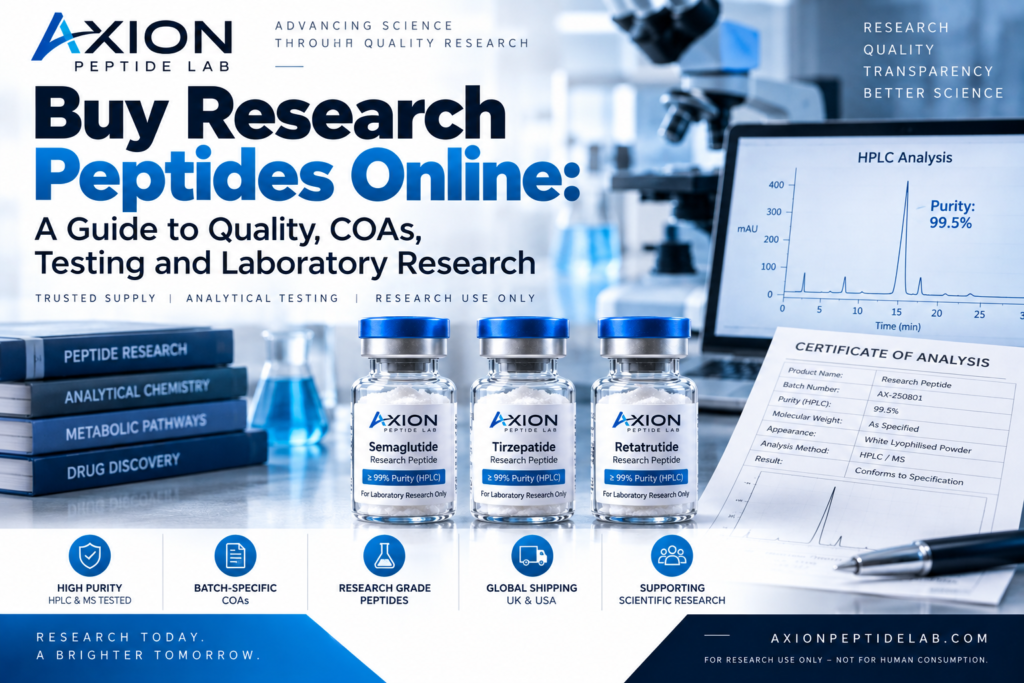
Axion Peptide Lab provides a growing catalogue of materials intended for laboratory and scientific research.
Different products relate to different areas of scientific investigation, so researchers should select materials according to their individual experimental protocols. research peptide products online
Examples from the catalogue include the following.
Retatrutide Research Peptide
Retatrutide has attracted substantial scientific interest because of research involving multiple metabolic signaling pathways.
Research surrounding the molecule has examined its activity in relation to glucagon-like peptide-1, glucose-dependent insulinotropic polypeptide, and glucagon receptor pathways.
Researchers investigating this area should distinguish published pharmaceutical research from research-use-only materials offered for laboratory investigation.
Axion Peptide Lab provides Retatrutide research products in multiple stated quantities, subject to availability.
Tirzepatide Research Peptide
Tirzepatide is another compound associated with significant metabolic and incretin-related research.
Scientific literature has investigated mechanisms involving GIP and GLP-1 receptor activity.
Laboratory researchers may examine molecular characteristics, signaling pathways, analytical properties, and other aspects relevant to their experimental models. research peptide products online
Research materials should not be confused with regulated prescription formulations containing related active ingredients. research peptide products online
Cagrilintide Research Peptide
Cagrilintide is associated with research involving amylin-related pathways.
Amylin itself is a peptide hormone involved in biological processes associated with metabolic regulation.
Research into amylin analogues and related compounds contributes to the broader scientific understanding of metabolic signaling.
Axion Peptide Lab offers Cagrilintide research material for appropriate laboratory applications.
GHK-Cu Research Peptide
GHK-Cu is a copper-binding peptide complex that has been investigated across several areas of laboratory research.
Researchers have studied its molecular characteristics and interactions in different experimental contexts.
Because GHK-Cu differs substantially from incretin-related compounds, it also demonstrates the diversity of materials that fall under the broad category of peptide research. research peptide products online
AOD-9604 Research Peptide
AOD-9604 is another peptide-related research compound available within the Axion Peptide Lab catalogue.
It has been investigated scientifically in relation to fragments associated with growth-hormone research.
Researchers should review relevant scientific literature and product documentation when determining whether a material is appropriate for a particular experimental protocol.
BPC-157 Research Peptide
BPC-157 is widely discussed in experimental research communities.
It has been investigated in preclinical contexts, but researchers should be particularly careful to distinguish experimental findings from established clinical evidence.
Research-use-only BPC-157 materials should not be represented as approved therapeutic products.
TB-500 Research Peptide
TB-500 is another material encountered within research peptide catalogues.
Researchers investigating peptide-related pathways should evaluate available scientific literature, analytical documentation, and product specifications before selecting materials for laboratory work. research peptide products online
BPC-157 + TB-500 Research Blend
Some experimental workflows may involve research blends containing more than one peptide-related material.
Axion Peptide Lab’s catalogue includes BPC-157 + TB-500 research blends.
Researchers working with blends should carefully document the identity and stated composition of the material because multi-component products create additional variables compared with single-compound research materials.
MOTS-c Research Peptide
MOTS-c has generated scientific interest in research involving mitochondrial biology and metabolic signaling.
Mitochondria play essential roles in cellular energy processes, making mitochondria-associated peptides an active area of biological investigation.
MOTS-c research remains an evolving scientific field, and experimental findings should be interpreted within the context of the specific research model being studied. research peptide products online
SEMAX Research Peptide
SEMAX is another peptide-related compound appearing within laboratory research catalogues.
Research interest has included neurological and molecular areas, although evidence can differ substantially according to the experimental context.
Researchers should rely on appropriate scientific literature rather than promotional claims when evaluating a compound.
Pinealon Research Products
Pinealon is another research material offered within the broader Axion Peptide Lab catalogue.
As with other research compounds, researchers should establish the intended experimental objective before selecting the product.
NAD Research Compounds
Axion Peptide Lab also provides NAD-related research materials.
Nicotinamide adenine dinucleotide is an important molecule in cellular biology and is widely studied in areas involving metabolism, redox reactions, and cellular processes.
NAD-related research products are not peptides in the strict structural sense, which is why accurate product categorization is important.
A research catalogue may contain both peptides and additional laboratory research compounds.
How to Compare Research Peptide Products Online
With many research materials available, researchers can benefit from a standardized comparison process.
Instead of choosing a product based on a single factor, create a comparison framework. research peptide products online
Step 1: Define the Research Objective
Determine exactly what scientific question the project is designed to investigate.
Step 2: Identify the Required Compound
Confirm the exact compound required by the experimental protocol.
Similar names do not necessarily indicate interchangeable materials.
Step 3: Determine the Required Quantity
Order quantities should align with the requirements of the planned research project.
Step 4: Review Product Specifications
Read the complete product listing rather than relying only on the product title.
Step 5: Review Available Documentation
Determine whether relevant analytical information is available.
Step 6: Record Batch Information
Where applicable, maintain batch or lot information within laboratory records.
Step 7: Check Storage Requirements
Make sure the laboratory can maintain appropriate storage conditions.
Step 8: Verify Shipping Availability
Confirm whether the product can be shipped to the research destination.
Step 9: Review Applicable Requirements
Consider institutional, legal, regulatory, customs, and procurement requirements.
Step 10: Maintain Procurement Records
Keep relevant purchasing and analytical documentation associated with the research project.
Building a Research Peptide Procurement Checklist
A standardized checklist can help laboratories make more consistent purchasing decisions.
Before ordering, researchers can ask:
- Is the compound clearly identified?
- Is the stated quantity correct?
- What product format is supplied?
- What purity information is provided?
- Which analytical methods are reported?
- Is a COA available?
- Can the product batch be identified?
- Are storage requirements provided?
- Is the product clearly designated for research?
- Can it be shipped to the destination?
- Are there applicable import restrictions?
- Does the product meet the requirements of the experimental protocol?
This approach helps transform online purchasing from an informal shopping process into a documented component of laboratory procurement. research peptide products online
Why Documentation Matters for Reproducible Research
Reproducibility is an important principle in scientific research.
Researchers attempting to understand or repeat an experiment need accurate information about the materials used. research peptide products online
Procurement records can contribute to this process.
Knowing the exact compound, supplier, batch, stated specifications, storage conditions, and experimental date can provide useful context when interpreting results.
If another batch is later used, researchers can document the change rather than treating all material bearing the same compound name as automatically identical.
Good documentation does not guarantee reproducibility, but poor documentation can make experimental interpretation more difficult. research peptide products online
The Importance of Product-Specific Research
Broad categories such as “peptides” include a large number of structurally and functionally different molecules.
Researchers should therefore avoid assuming that information about one peptide applies automatically to another.
Retatrutide, GHK-Cu, BPC-157, MOTS-c, and SEMAX, for example, are investigated in substantially different scientific contexts.
Even compounds associated with related research areas may differ in molecular structure, mechanisms, analytical characteristics, and experimental relevance.
Product-specific scientific literature should therefore guide research decisions. research peptide products online
Reading Scientific Literature Before Ordering
Researchers evaluating research peptide products online should consider reviewing scientific literature before procurement. research peptide products online
Scientific publications can help researchers understand:
- Molecular characteristics
- Research history
- Experimental models
- Analytical methods
- Known limitations
- Areas requiring further investigation
Peer-reviewed literature can also help researchers separate established findings from unsupported online claims.
A commercial product page should never replace a scientific literature review when designing an experiment.
Avoiding Misleading Peptide Claims
Peptide research is an active field, but online discussions sometimes move beyond what scientific evidence actually establishes.
Researchers should distinguish between:
- Laboratory findings
- Animal research
- Early-stage experimental findings
- Human clinical research
- Regulatory approval
- Marketing claims
These categories are not equivalent.
A result observed in a laboratory model does not automatically establish the same outcome in humans.
Likewise, scientific investigation of a molecule does not mean a research-use-only version of that compound has been approved for therapeutic use.
Responsible scientific communication should preserve these distinctions.
Research Peptides and Laboratory Record Keeping
Good laboratory records should begin when a research material is ordered, not only when an experiment starts.
A useful internal product record may include:
Compound: Exact research material name
Supplier: Supplier from which the material was obtained
Quantity: Stated amount received
Batch/Lot: Relevant identifier where available
Date Ordered: Procurement date
Date Received: Arrival date
Documentation: COA or other analytical information
Storage: Required storage conditions
Location: Internal laboratory storage location
Project: Associated research project
Experimental Use: Dates or experiments involving the material
These records can make inventory management more organized and improve traceability throughout the research process.
Long-Term Research Projects and Peptide Procurement
Long-term studies introduce additional procurement considerations.
A research project lasting several months may require multiple orders of the same compound.
Researchers should consider whether:
- Multiple batches may be required
- Batch changes need documentation
- Storage capacity is sufficient
- Product availability may change
- Analytical documentation should be archived
- International shipping times could affect the experimental schedule
Planning these factors before the project begins can reduce unnecessary interruptions.
Why Cheap Research Peptides Are Not Always the Best Choice
Research budgets matter.
However, the lowest advertised price should not automatically determine which material a laboratory purchases.
Researchers should consider overall procurement value.
A slightly lower price may be less meaningful if essential product information is unavailable or if the laboratory cannot determine which batch corresponds to the supplied documentation.
A useful purchasing decision balances:
- Product specifications
- Documentation
- Traceability
- Supplier transparency
- Shipping
- Storage
- Research requirements
- Cost
Price remains relevant, but it belongs within a broader evaluation.
Research Peptide Products in the USA
Researchers purchasing peptide materials in the United States should determine which institutional and regulatory requirements apply to their work.
Research-use labeling does not eliminate the responsibility to evaluate how a compound can appropriately be obtained and used.
University laboratories, private research facilities, commercial laboratories, and independent organizations may also operate under different procurement policies.
Researchers should follow the requirements applicable to their particular environment.
International Research Peptide Purchasing
International procurement requires additional attention.
Countries can have different rules concerning laboratory materials and individual compounds.
Customs classifications, import documentation, carrier restrictions, and local requirements can also change.
Researchers should verify requirements for their destination before placing an international order.
Axion Peptide Lab offers worldwide shipping subject to applicable regulations, product availability, carrier requirements, and destination restrictions.
Worldwide shipping should not be interpreted as a guarantee that every product can be shipped to every country.
How Axion Peptide Lab Fits Into Research Procurement
Axion Peptide Lab provides a catalogue of peptide and related materials intended for appropriate scientific and laboratory research.
The catalogue allows researchers to explore individual compounds, stated quantities, and relevant product information.
When selecting products, researchers should still evaluate each material according to their own experimental requirements.
No supplier can determine experimental suitability without understanding the research protocol.
Researchers should therefore combine supplier information with scientific literature, institutional procedures, and appropriate analytical considerations.
Internal Research Categories to Explore
Researchers browsing Axion Peptide Lab can organize their investigation around broader scientific categories rather than treating every compound as interchangeable.
Potential areas include:
Metabolic and Incretin-Related Research
Examples include Retatrutide, Tirzepatide, and Cagrilintide.
Copper Peptide Research
GHK-Cu represents a distinct area of peptide investigation involving a copper-binding peptide complex.
Mitochondrial Research
MOTS-c is associated with research involving mitochondrial biology.
Experimental Peptide Research
Compounds such as BPC-157 and TB-500 appear within experimental peptide research literature.
Neurological and Molecular Research
SEMAX and Pinealon have been investigated within different experimental contexts.
Each category requires its own literature review and experimental methodology.
Frequently Asked Questions About Research Peptide Products Online
What are research peptide products?
Research peptide products are peptide materials intended for scientific, analytical, or laboratory investigation rather than human consumption or therapeutic use.
Where can researchers find research peptide products online?
Researchers can obtain materials from suppliers specializing in research peptides and laboratory compounds. Supplier transparency, product information, documentation, traceability, and applicable requirements should be evaluated before purchasing. research peptide products online
What should I check before purchasing a research peptide?
Check the exact compound, stated quantity, product format, purity information, available analytical documentation, batch information, storage requirements, supplier details, and shipping availability.
Why is peptide purity important?
Purity provides information about the relative amount of the target peptide compared with detectable peptide-related impurities under the analytical method used.
What does a peptide COA show?
A COA may contain information such as product identity, batch number, analytical methods, purity results, testing dates, and other relevant specifications.
What is HPLC?
High-Performance Liquid Chromatography is an analytical technique used to separate components within a sample and is commonly encountered in peptide purity analysis.
What is mass spectrometry?
Mass spectrometry is an analytical technique that provides information related to molecular mass and can assist researchers with compound characterization. research peptide products online
Why do batch numbers matter?
Batch numbers improve traceability by helping researchers associate physical materials with procurement records, analytical documentation, and particular experiments.
What are lyophilized research peptides?
Lyophilized peptides have undergone a controlled freeze-drying process that removes water from the material.
Are research peptides prescription medicines?
No. Research-use-only peptide materials should not be treated as approved prescription medicines simply because the same or related molecules may appear in pharmaceutical research.
Does Axion Peptide Lab provide Retatrutide research products?
Axion Peptide Lab’s research catalogue includes Retatrutide research materials in various stated quantities, subject to current availability and destination requirements.
Does Axion Peptide Lab provide Tirzepatide research products?
The catalogue includes Tirzepatide research materials intended for appropriate laboratory applications.
Are GHK-Cu research products available?
GHK-Cu is among the research materials offered within the Axion Peptide Lab catalogue, subject to availability.
Can research peptides be shipped worldwide?
International shipping depends on the individual product, destination, carrier requirements, customs procedures, and applicable regulations.
How should research peptide products be stored?
Storage requirements can vary by compound. Researchers should follow product-specific documentation and appropriate laboratory procedures rather than assuming all peptides require identical conditions.
Final Thoughts: Evaluating Research Peptide Products Online
Finding research peptide products online can provide laboratories with convenient access to a diverse range of materials, but responsible procurement requires more than selecting a product and completing an order.
Researchers should evaluate compound identity, purity information, analytical documentation, batch traceability, product format, storage requirements, supplier transparency, scientific literature, shipping conditions, and applicable regulatory requirements. research peptide products online
The scientific objective should remain at the center of every purchasing decision.
Axion Peptide Lab provides a growing catalogue of peptide and related research materials, including Retatrutide, Tirzepatide, Cagrilintide, GHK-Cu, AOD-9604, BPC-157, TB-500, MOTS-c, SEMAX, Pinealon, NAD-related research compounds, and selected research blends.
Researchers should consult individual product information and relevant scientific literature to determine which materials align with their experimental requirements.
Careful procurement, transparent documentation, appropriate storage, and accurate laboratory records can help create a more organized research workflow from the moment a product is selected through its eventual experimental use.
For Research Use Only – Not for human consumption.
For authoritative regulatory information about peptide products and their development, see the FDA’s guidance on peptide drug products: https://www.fda.gov/regulatory-information/search-fda-guidance-documents/clinical-pharmacology-considerations-peptide-drug-products
For current scientific publications covering peptide biology, chemistry, and research applications, explore Nature’s peptide research collection: https://www.nature.com/subjects/peptide
Researchers looking for peer-reviewed scientific literature can explore PubMed’s extensive collection of peptide studies: https://pubmed.ncbi.nlm.nih.gov/?term=peptides
For a scientific introduction to laboratory peptide synthesis and commonly used research methods, see this PubMed resource: https://pubmed.ncbi.nlm.nih.gov/22851497/
For detailed information about chemical methods used in peptide production, this peer-reviewed scientific review provides useful background: https://pmc.ncbi.nlm.nih.gov/articles/PMC6270108/
For information about modern methods used to identify and characterize peptides, see Nature Reviews Methods Primers on peptidomics: https://www.nature.com/articles/s43586-023-00205-2