Peptide Laboratory Supplier Online: 13 Essential Standards for Choosing a Reliable Research Source
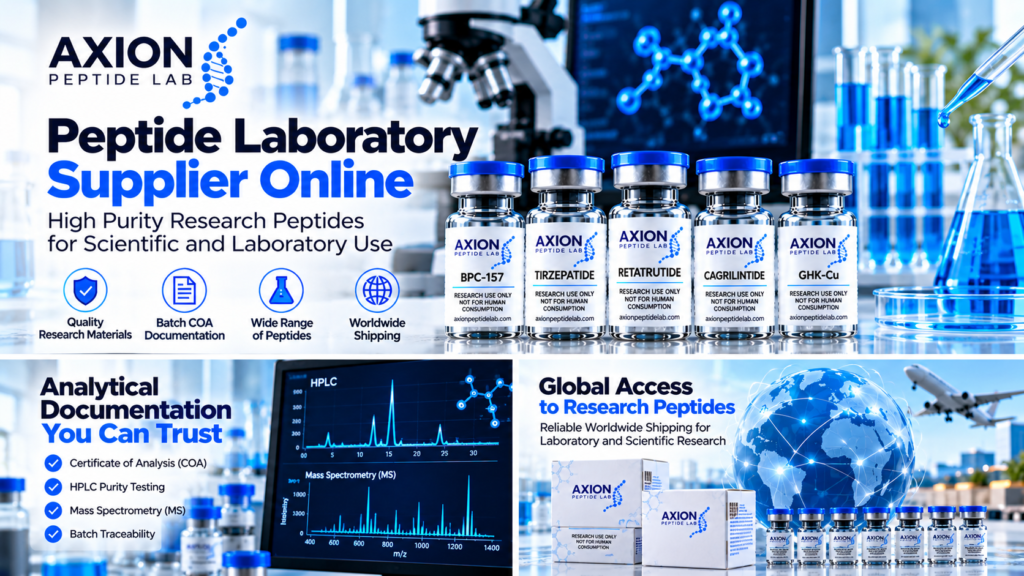
Finding a reliable peptide laboratory supplier online requires more than searching for the largest catalogue or the lowest advertised price. Laboratories, researchers, analytical facilities, and scientific organizations should evaluate the quality of the information surrounding each research material, including product identity, stated purity, analytical documentation, batch traceability, storage requirements, supplier transparency, shipping policies, and research-use positioning.
Peptide science covers an enormous range of molecular structures and experimental applications. Researchers may investigate peptides in analytical chemistry, molecular biology, biochemical signaling, receptor research, metabolic pathways, mitochondrial biology, peptide chemistry, stability studies, and many other scientific fields.
As interest in peptide research continues to expand, laboratories have access to an increasing number of suppliers and research products online. peptide laboratory supplier online
Greater choice can be useful, but it also creates an important question:
How should researchers evaluate an online peptide laboratory supplier?
The answer should not depend on one marketing claim. peptide laboratory supplier online
Instead, laboratories can establish a systematic supplier-evaluation process that considers scientific information, documentation, traceability, product organization, communication, and procurement requirements.
This guide explains 13 essential standards to consider when evaluating an online peptide research supplier and explores how products available through Axion Peptide Lab can fit into properly designed laboratory investigations.
For Research Use Only – Not for human consumption.
What Is a Peptide Laboratory Supplier?
A peptide laboratory supplier provides peptide materials and related research products intended for scientific, analytical, or laboratory investigation.
Depending on the supplier, a catalogue may include:
- Individual research peptides
- Peptide complexes
- Research blends
- Lyophilized peptide materials
- Related biochemical research compounds
- Laboratory supplies
- Analytical information
- Batch documentation
Not every supplier provides the same product categories or supporting information.
Researchers should therefore avoid assuming that every website using terms such as “research peptide supplier” or “laboratory peptide supplier” operates according to identical standards.
The individual product and supplier should both be evaluated.
Why Researchers Use Online Peptide Suppliers
Scientific procurement has increasingly moved online.
Researchers can now review large research catalogues, compare compounds, evaluate product specifications, examine documentation, and communicate with suppliers without relying entirely on printed catalogues.
Online research procurement can provide several practical advantages. peptide laboratory supplier online
Wider Product Discovery
Researchers can quickly identify compounds relevant to different areas of investigation.
Easier Product Comparison
Multiple products can be compared according to quantity, format, documentation, and other specifications.
Faster Access to Information
Product descriptions, analytical information, and research-use designations may be available directly from the supplier’s website.
International Accessibility
Research organizations may be able to identify suppliers beyond their immediate geographic region.
However, convenience should not replace proper scientific evaluation.
A professional procurement process should still be followed.
1. Evaluate Product Identification
The first standard for evaluating a peptide laboratory supplier online is product clarity.
Researchers should be able to determine exactly what is being offered.
A research product page may identify:
- Compound name
- Stated quantity
- Physical format
- Product code
- Research-use designation
- Batch information
- Storage information
- Relevant molecular specifications
The information provided will vary according to the compound.
Researchers should be cautious about vague listings that make it difficult to determine exactly what material is being supplied.
Accurate product identification becomes especially important when a laboratory works with several similar compounds.
2. Review the Supplier’s Research-Use Positioning
A legitimate research-focused catalogue should clearly distinguish laboratory materials from products intended for human consumption.
This distinction matters scientifically and commercially.
Research-use-only materials should be described using language focused on:
- Laboratory investigation
- Molecular research
- Analytical characterization
- Scientific literature
- Compound properties
- Experimental models
- Research documentation
They should not be represented as substitutes for approved medicines.
Axion Peptide Lab clearly positions applicable products as:
For Research Use Only – Not for human consumption.
This wording should reflect the genuine purpose of the product and surrounding marketing.
A disclaimer alone should never be used to disguise consumer-oriented or therapeutic promotion.
3. Examine Stated Peptide Purity
Purity is one of the specifications researchers commonly evaluate when comparing suppliers.
However, researchers should understand what purity information represents.
Peptide purity generally refers to the proportion of the target peptide compared with detectable peptide-related impurities under a particular analytical method.
A purity percentage should therefore be interpreted alongside the analytical method used.
Researchers can ask:
- What method produced the result?
- Which batch was analyzed?
- Is the tested compound clearly identified?
- Is analytical documentation available?
- Does the specification meet the requirements of the experiment?
Simply displaying a high percentage does not answer every question about a research material.
Scientific evaluation requires context. peptide laboratory supplier online
4. Look for Analytical Documentation
Documentation can help researchers better understand the material they are purchasing.
A Certificate of Analysis, commonly known as a COA, may provide analytical information associated with a product or batch.
Depending on the compound and analysis performed, information may include:
- Product name
- Batch or lot number
- Testing date
- Stated purity
- Analytical method
- Molecular information
- Test results
- Additional specifications
Researchers should examine the actual information rather than simply checking whether the supplier uses the phrase “COA available.”
A useful document should provide enough information for researchers to understand what was tested and, where applicable, which batch the results represent.
5. Understand HPLC Purity Testing
High-Performance Liquid Chromatography, or HPLC, is frequently encountered in peptide analysis.
HPLC separates components of a sample based on their interactions with the chromatographic system.
In peptide research, this technique may be used to evaluate sample composition and estimate relative purity.
A chromatogram may contain several peaks.
The interpretation of these peaks depends on factors including:
- Chromatographic method
- Column
- Mobile phase
- Detection conditions
- Sample preparation
- Integration method
Researchers comparing suppliers should therefore avoid treating an HPLC percentage as an isolated marketing number.
The method and documentation provide additional context.
6. Understand the Role of Mass Spectrometry
Mass spectrometry is another important analytical technique in molecular research.
It can provide information related to molecular mass and assist with compound characterization.
Researchers may encounter terms such as:
- MS
- LC-MS
- ESI-MS
- Molecular mass
- Mass spectrum
Mass spectrometry and chromatography provide different types of analytical information.
When both forms of data are available, they may provide researchers with a broader analytical picture than either method considered alone.
The exact testing required depends on the scientific objective.
7. Check Batch and Lot Traceability
A strong peptide laboratory supplier online should make it possible for researchers to maintain useful procurement records.
Batch or lot identification is important because laboratories may purchase the same compound more than once.
Consider a research project that lasts six months.
A laboratory may use one batch during the first three months and another batch during the remaining experiments.
Without accurate records, researchers may later struggle to determine which batch was associated with particular results.
A useful laboratory record can include:
Compound: Exact research material
Supplier: Source
Product code: Catalogue identifier
Batch/Lot: Batch reference
Quantity: Stated amount
Date ordered: Procurement date
Date received: Arrival date
COA: Associated documentation
Storage: Laboratory storage location
Project: Associated research study
Experiment: Specific experimental references
Traceability helps create more organized research records.
8. Review Product Format
Researchers should understand the physical format in which a material is supplied.
Many research peptides are available in lyophilized form.
What Is Lyophilization?
Lyophilization is a freeze-drying process that removes water from a material under controlled conditions.
The process generally involves freezing the material and removing water through sublimation under reduced pressure.
Lyophilized research material can appear in different physical forms.
It may look like:
- Fine powder
- Compact material
- Cake-like material
- Thin residue within the vial
Appearance alone should not be used to determine identity, quantity, or purity.
Researchers should rely on appropriate analytical documentation and product information.
9. Evaluate Storage Information
Storage is an important component of research-material management.
Peptides can differ in stability.
Relevant environmental factors may include:
- Temperature
- Moisture
- Light
- Oxidation
- Time
- Container integrity
- Repeated environmental changes
A supplier should provide appropriate storage information where available.
Researchers should also consult compound-specific scientific literature and their institutional laboratory procedures.
It is important not to assume that every peptide requires identical storage conditions.
The molecular characteristics of different compounds can vary substantially.
10. Review the Breadth of the Research Catalogue
A broad catalogue can make procurement more convenient for laboratories investigating multiple compounds.
However, catalogue size should never replace quality evaluation.
Researchers should evaluate each product independently.
Axion Peptide Lab maintains a research catalogue covering several areas of peptide and biochemical investigation.
Examples include:
- Retatrutide
- Tirzepatide
- Cagrilintide
- GHK-Cu
- AOD-9604
- BPC-157
- TB-500
- MOTS-c
- SEMAX
- Pinealon
- Research blends
- NAD research compounds
These materials represent different areas of scientific investigation and should not be treated as interchangeable.
A useful supplier catalogue should make it easier for researchers to identify these distinctions.
11. Evaluate Supplier Communication
Scientific procurement occasionally requires clarification.
Researchers may need to ask about:
- Product availability
- Batch information
- Documentation
- Quantities
- Shipping
- Storage information
- Order status
A supplier should therefore provide a clear method of communication.
For Axion Peptide Lab, research and order inquiries can be directed through the official business contact channels provided on the website.
Good communication does not replace analytical quality, but it can make procurement more organized. peptide laboratory supplier online
12. Examine Shipping Information
Research materials may need to travel significant distances between the supplier and laboratory.
Researchers should review:
- Shipping destinations
- Carrier options
- Estimated handling
- Customs requirements
- Destination restrictions
- Product restrictions
- Applicable regulations
International availability does not automatically mean every product can be shipped to every country.
Researchers should verify whether the intended research material can appropriately be imported into the destination jurisdiction. peptide laboratory supplier online
13. Compare Overall Research Value
Price matters, particularly for laboratories operating within strict budgets.
However, researchers should avoid evaluating suppliers based exclusively on price.
A stronger evaluation considers:
- Product identity
- Stated purity
- Analytical information
- Batch traceability
- Product format
- Storage information
- Supplier transparency
- Communication
- Shipping
- Cost
The objective is to find a research material that meets the requirements of the experiment.
The lowest price may not provide the best overall research value. peptide laboratory supplier online
What Makes a Reliable Peptide Laboratory Supplier Online?
There is no single characteristic that establishes supplier reliability.
Instead, researchers should look at the complete procurement experience.
A strong research supplier should provide clear answers to several questions.
What Is the Product?
Researchers should immediately understand what compound is being offered.
What Quantity Is Supplied?
The stated quantity should be clearly displayed. peptide laboratory supplier online
What Documentation Is Available?
Researchers should know whether relevant analytical information exists.
Can the Batch Be Identified?
Batch traceability can support laboratory record keeping.
How Should the Product Be Stored?
Storage information should be available where appropriate.
What Is the Intended Use?
Research materials should be clearly designated for scientific and laboratory investigation.
Can the Supplier Be Contacted?
Communication channels should be available for research and order questions.
Where Can the Product Be Shipped?
Shipping availability and limitations should be explained.
Research Products Available From Axion Peptide Lab
A useful way to evaluate a peptide supplier is to examine whether its catalogue covers relevant research categories while maintaining clear product distinctions.
Axion Peptide Lab provides multiple peptide and related research materials.
Retatrutide Research Products
Retatrutide is associated with scientific investigation involving several metabolic signaling pathways.
Published research has examined the molecule in relation to glucagon, GIP, and GLP-1 receptor activity.
This makes Retatrutide relevant to a distinct area of metabolic and receptor research.
Axion Peptide Lab provides Retatrutide research materials in multiple stated quantities, subject to current availability.
Researchers should review the individual product information before procurement.
For Research Use Only – Not for human consumption.
Tirzepatide Research Products
Tirzepatide is associated with research involving GIP and GLP-1 receptor pathways.
The molecule has generated significant scientific interest in metabolic signaling research.
Laboratories may investigate aspects such as:
- Molecular interactions
- Receptor pathways
- Analytical characteristics
- Stability
- Comparative signaling research
Research materials containing Tirzepatide should remain clearly separated from regulated prescription pharmaceutical products containing the same active molecule.
Cagrilintide 5mg Research Peptide
Cagrilintide is associated with amylin-related scientific research.
Amylin is a peptide hormone involved in metabolic signaling.
Research involving analogues and related compounds contributes to broader investigation of peptide-mediated biological pathways.
Axion Peptide Lab provides Cagrilintide 5mg research material for appropriate laboratory investigation.
GHK-Cu 50mg Research Peptide
GHK-Cu is a copper-binding peptide complex.
It represents a substantially different research category from compounds associated with incretin signaling.
Scientists have investigated GHK-Cu in several molecular and cellular contexts.
Researchers selecting GHK-Cu should review compound-specific literature rather than assuming information about unrelated peptides applies to this material.
AOD-9604 5mg Research Peptide
AOD-9604 is another research material within the Axion Peptide Lab catalogue.
It has appeared in experimental research associated with growth-hormone-fragment investigation.
Researchers should examine the specific scientific literature relevant to their experimental objective.
BPC-157 Research Peptide
BPC-157 appears frequently in experimental peptide research.
Much of the scientific discussion surrounding BPC-157 involves preclinical or laboratory investigation.
Researchers should therefore be especially careful to distinguish experimental findings from established clinical evidence.
Axion Peptide Lab’s BPC-157 materials are intended for laboratory investigation.
TB-500 Research Material
TB-500 is another material available for appropriate scientific investigation.
Researchers interested in TB-500 should evaluate the compound according to the requirements of their experimental protocol.
The catalogue also includes selected blends containing BPC-157 and TB-500.
Glow 70mg Research Blend
Axion Peptide Lab’s Glow research blend combines GHK-Cu, BPC-157, and TB-500 research materials.
Research blends require careful experimental planning.
When several compounds are combined into one research material, researchers should clearly record:
- Individual components
- Stated composition
- Quantity
- Batch
- Experimental objective
A multi-component research blend may not be suitable when the research design requires individual compounds to be evaluated independently.
MOTS-c 10mg Research Peptide
MOTS-c has attracted scientific interest in mitochondrial and metabolic research.
Mitochondria play fundamental roles in cellular energy processes.
Researchers investigating MOTS-c should consider the experimental model, scientific literature, analytical methods, and specific research question before procurement.
SEMAX Research Products
SEMAX has been investigated within several experimental research contexts.
Researchers interested in this compound should distinguish preliminary or experimental findings from established clinical conclusions.
Research products should remain framed according to their laboratory purpose.
Pinealon Research Products
Pinealon is another research material within the Axion catalogue.
Researchers evaluating Pinealon should begin with the scientific literature and determine whether the material fits the experimental objective.
Product specifications should then be evaluated according to the study requirements.
NAD Research Compounds
Axion Peptide Lab also carries NAD-related research materials.
Nicotinamide adenine dinucleotide plays an important role in cellular biology, including redox chemistry and metabolic processes.
NAD is not structurally a peptide.
This distinction demonstrates why a well-organized research supplier should accurately categorize different laboratory compounds rather than placing every product under the same molecular classification.
Why Product Diversity Matters for Research Laboratories
Laboratories may investigate several molecular systems during a research program.
A broader supplier catalogue can simplify procurement by allowing researchers to explore multiple categories in one location.
However, diversity should never encourage researchers to treat unrelated compounds as equivalent.
For example:
Retatrutide is associated with multi-receptor metabolic signaling research.
Tirzepatide is associated with GIP and GLP-1 receptor research.
Cagrilintide is associated with amylin-related research.
GHK-Cu is a copper-binding peptide complex.
MOTS-c is associated with mitochondrial research.
NAD is a non-peptide molecule central to cellular chemistry.
These represent different molecular and scientific categories.
Researchers should therefore select materials according to their research question rather than according to popularity.
How to Compare Two Peptide Laboratory Suppliers
Researchers may identify several potential suppliers.
A structured comparison can make the decision easier.
Supplier A vs Supplier B: Product Information
Compare whether both suppliers clearly identify the compound and quantity.
Documentation
Determine what analytical information is available. peptide laboratory supplier online
Batch Traceability
Check whether relevant batch information can be recorded.
Storage Information
Determine whether appropriate storage information is available.
Research Positioning
Examine whether products are genuinely marketed for laboratory investigation.
Communication
Check whether the supplier provides a clear contact method.
Shipping
Compare destination availability and applicable restrictions.
Price
Finally, compare price after evaluating the scientific and logistical factors.
This sequence helps prevent price from becoming the only purchasing criterion. peptide laboratory supplier online
Creating a Supplier Evaluation Scorecard
Laboratories can create an internal supplier scorecard.
For example:
Product Identification — 10 Points
Is the compound clearly identified?
Documentation — 10 Points
Is useful analytical information available?
Batch Traceability — 10 Points
Can materials be associated with a batch or lot?
Product Information — 10 Points
Are quantity, format, and relevant specifications clearly presented?
Storage Guidance — 10 Points
Is appropriate storage information provided?
Research-Use Clarity — 10 Points
Is the product clearly positioned for scientific investigation?
Communication — 10 Points
Can researchers obtain clarification?
Shipping Information — 10 Points
Are delivery conditions and restrictions explained?
Catalogue Organization — 10 Points
Can researchers easily locate relevant products?
Overall Procurement Value — 10 Points
Does the product and supplier combination meet the needs of the research project?
This creates a possible 100-point internal evaluation.
The scoring system does not establish scientific quality by itself.
Its purpose is to make supplier comparison more systematic.
Peptide Laboratory Supplier Online vs General Chemical Marketplace
Specialized peptide suppliers and broad chemical marketplaces can differ significantly.
A specialized supplier may organize products specifically around peptide and related research categories.
This can make it easier to locate:
- Peptide products
- Related compounds
- Product-specific documentation
- Research-use information
- Relevant quantities
A general marketplace may contain a much broader range of chemicals.
Neither model automatically establishes product quality.
Researchers should still evaluate the individual product and supplier. peptide laboratory supplier online
Research Peptide Supplier USA Considerations
Researchers searching for a peptide laboratory supplier in the United States should consider both scientific and regulatory factors.
Procurement requirements can differ according to the organization. peptide laboratory supplier online
A university laboratory may operate under institutional purchasing rules. peptide laboratory supplier online
A private research facility may have its own supplier-approval process.
A commercial analytical laboratory may maintain detailed material qualification procedures.
Researchers should follow the requirements applicable to their environment. peptide laboratory supplier online
International Peptide Laboratory Supplier Considerations
International research procurement introduces additional factors.
Researchers should consider:
- Destination regulations
- Import requirements
- Customs procedures
- Carrier restrictions
- Institutional rules
- Product-specific restrictions
Researchers should verify these requirements before placing an international order.
Axion Peptide Lab provides worldwide delivery options subject to applicable regulations, destination availability, customs requirements, and carrier restrictions. peptide laboratory supplier online
Why Supplier Documentation Should Be Saved
Laboratories should consider preserving relevant supplier documentation after purchasing research materials.
Product pages can change.
New batches may replace older batches. peptide laboratory supplier online
Analytical documents may also be updated.
Researchers may therefore preserve:
- Product information
- COA
- Batch information
- Order confirmation
- Receipt date
- Storage record
This information can later be associated with the experiments in which the material was used.
The Relationship Between Procurement and Reproducibility
Procurement may seem separate from experimental science, but the two are closely connected.
Researchers attempting to reproduce an experiment need accurate information about the materials involved.
A research record that simply says:
“Retatrutide was used.”
provides limited procurement information.
A more complete laboratory record could contain:
Compound: Retatrutide
Supplier: Research supplier
Batch: Recorded batch number
Quantity: Recorded quantity
Documentation: Associated analytical information
Storage: Recorded conditions
Experiment: Internal reference
This creates a more complete experimental record. peptide laboratory supplier online
Evaluating Peptides for Long-Term Research
Long-term research projects require additional procurement planning.
Researchers may need to determine:
- Total expected material requirements
- Whether multiple batches will be needed
- Storage capacity
- Product stability
- Supplier availability
- Shipping lead times
- Documentation requirements
- Budget
A laboratory should avoid purchasing materials without considering how they will be managed throughout the project. peptide laboratory supplier online
Why Scientific Literature Matters When Choosing Products
A supplier’s website can provide product information, but it should not replace scientific literature.
Researchers should review relevant publications before selecting a compound. peptide laboratory supplier online
Scientific literature can provide information about:
- Molecular structure
- Experimental history
- Research models
- Analytical methods
- Biological pathways
- Limitations
- Areas requiring further investigation
Researchers can use databases such as PubMed to identify scientific publications relevant to a particular peptide.
Supplier information and scientific literature serve different purposes.
Both can contribute to informed procurement.
Avoiding Unsupported Research Claims
Researchers should be cautious when product descriptions make claims extending beyond available scientific evidence.
Scientific findings exist at different levels.
These can include:
- Chemical characterization
- Laboratory research
- Cell-based studies
- Animal research
- Early human investigation
- Controlled clinical research
- Regulatory review and approval
These levels should not be treated as equivalent.
A laboratory observation does not automatically establish a human outcome.
Likewise, the fact that a compound is being investigated in clinical research does not transform a research-use-only material sold online into an approved medicine. peptide laboratory supplier online
Responsible research suppliers should preserve these distinctions. peptide laboratory supplier online
Questions to Ask a Peptide Laboratory Supplier Online
Before purchasing, researchers can consider the following questions:
- What exactly is the compound?
- What quantity is supplied?
- What physical format is provided?
- What purity is stated?
- Which analytical method produced the result?
- Is a COA available?
- Can the batch be identified?
- What storage information is provided?
- Is the material clearly intended for research?
- Can the supplier answer product questions?
- Is shipping available to the destination?
- Are there applicable import requirements?
- Does the material meet the experimental requirements?
These questions create a practical foundation for supplier evaluation. peptide laboratory supplier online
Common Mistakes When Choosing a Research Peptide Supplier
Researchers can improve procurement by avoiding several common mistakes. peptide laboratory supplier online
Choosing Only by Price
Price should be considered alongside documentation and research requirements. peptide laboratory supplier online
Trusting a Purity Number Without Context
Researchers should understand the analytical method associated with the result.
Ignoring Batch Information
Traceability becomes more difficult without batch records.
Failing to Save Documentation
Relevant product information may change over time.
Ignoring Storage Requirements
Improper storage can affect research materials.
Treating Every Peptide as Similar
Different peptides can have very different molecular characteristics. peptide laboratory supplier online
Confusing Research Products With Medicines
Research materials should remain separate from approved pharmaceutical products.
Ignoring International Requirements
Shipping availability does not eliminate import or destination requirements.
20-Point Peptide Supplier Checklist
Before choosing a peptide laboratory supplier online, researchers can use this checklist:
- Clear supplier identity
- Professional research catalogue
- Clear compound names
- Clearly stated quantities
- Research-use designation
- Purity information
- Analytical methodology
- COA availability where applicable
- Batch identification
- Product-format information
- Storage guidance
- Organized catalogue categories
- Scientific rather than therapeutic language
- Contact information
- Shipping information
- International-delivery conditions
- Destination restrictions
- Product-specific information
- Reasonable procurement transparency
- Compatibility with the laboratory’s research requirements
The checklist should complement, not replace, independent scientific evaluation. peptide laboratory supplier online
Frequently Asked Questions About Peptide Laboratory Suppliers
What is a peptide laboratory supplier?
A peptide laboratory supplier provides peptide materials and related compounds intended for scientific, analytical, or laboratory research. peptide laboratory supplier online
How do I choose a peptide laboratory supplier online?
Evaluate product identification, stated purity, analytical documentation, batch traceability, storage information, research-use positioning, communication, shipping policies, and overall procurement value.
What should a research peptide product page include?
Useful information may include the compound name, quantity, physical format, research-use designation, purity information, batch information, analytical documentation, and storage guidance.
What is peptide purity?
Peptide purity generally describes the relative proportion of the target peptide compared with detectable peptide-related impurities under a specific analytical method. peptide laboratory supplier online
What is a peptide COA?
A Certificate of Analysis can contain information such as product identity, batch number, stated purity, analytical methods, test results, and testing date.
Why is HPLC used for peptides?
HPLC separates components within a sample and is commonly used to evaluate peptide composition and relative purity.
Why is mass spectrometry useful?
Mass spectrometry can provide information related to molecular mass and assist researchers in characterizing molecular materials.
Why do batch numbers matter?
Batch identification helps laboratories associate materials with analytical documentation, purchasing records, and specific experiments.
Are lyophilized peptides research materials?
Lyophilization is a common physical preparation method for various research materials. Researchers should evaluate the specific product and its intended research use.
Does Axion Peptide Lab provide Retatrutide research products?
Axion Peptide Lab’s research catalogue includes Retatrutide research materials in several stated quantities, subject to availability. peptide laboratory supplier online
Does Axion Peptide Lab provide Tirzepatide research materials?
The catalogue includes Tirzepatide materials intended for appropriate laboratory and scientific research.
Is GHK-Cu available?
GHK-Cu 50mg is among the research materials available through the Axion Peptide Lab catalogue, subject to availability.
Is Cagrilintide available?
Axion Peptide Lab offers Cagrilintide 5mg research material for appropriate scientific investigation.
Are peptide blends available?
Selected research blends containing compounds such as GHK-Cu, BPC-157, and TB-500 are available within the catalogue. peptide laboratory supplier online
Does Axion Peptide Lab carry MOTS-c?
MOTS-c 10mg is included within the Axion research catalogue for appropriate laboratory applications.
Does Axion Peptide Lab offer NAD research products?
Yes. NAD-related research materials are part of the broader catalogue, although NAD itself is not structurally classified as a peptide. peptide laboratory supplier online
Can research peptides be shipped internationally?
Shipping depends on the product, destination, applicable regulations, customs requirements, and carrier policies.
Are research peptides prescription medicines?
No. Research-use-only peptide materials should not be treated as approved prescription medicines.
Should researchers keep supplier documentation?
Maintaining product, batch, analytical, procurement, and storage records can improve laboratory traceability and organization.
Final Thoughts: Choosing a Peptide Laboratory Supplier Online
Choosing a reliable peptide laboratory supplier online should be treated as part of the scientific procurement process rather than a simple online shopping decision.
Researchers should begin with their experimental requirements.
Identify the compound.
Determine the required quantity.
Review the product specifications.
Understand the stated purity.
Examine available analytical documentation.
Record batch information.
Confirm the physical format.
Review storage requirements.
Evaluate supplier transparency.
Consider shipping and destination requirements.
Finally, preserve relevant documentation after the material arrives.
Axion Peptide Lab provides a growing research catalogue that includes Retatrutide, Tirzepatide, Cagrilintide, GHK-Cu, AOD-9604, BPC-157, TB-500, MOTS-c, SEMAX, Pinealon, research blends, NAD research compounds, and additional materials for appropriate scientific investigation.
A broad catalogue can make product discovery easier, but every research material should still be evaluated individually.
The most useful supplier is not necessarily the one displaying the largest number of products or the lowest prices.
For scientific procurement, researchers should prioritize clear identification, useful documentation, traceability, appropriate product information, and compatibility with their experimental requirements.
Those standards can help laboratories create a more systematic procurement process while maintaining better research records throughout the life of a project. peptide laboratory supplier online
For Research Use Only – Not for human consumption.
For authoritative regulatory information about peptide products and their development, see the FDA’s guidance on peptide drug products: https://www.fda.gov/regulatory-information/search-fda-guidance-documents/clinical-pharmacology-considerations-peptide-drug-products
For current scientific publications covering peptide biology, chemistry, and research applications, explore Nature’s peptide research collection: https://www.nature.com/subjects/peptide
Researchers looking for peer-reviewed scientific literature can explore PubMed’s extensive collection of peptide studies: https://pubmed.ncbi.nlm.nih.gov/?term=peptides
For a scientific introduction to laboratory peptide synthesis and commonly used research methods, see this PubMed resource: https://pubmed.ncbi.nlm.nih.gov/22851497/
For detailed information about chemical methods used in peptide production, this peer-reviewed scientific review provides useful background: https://pmc.ncbi.nlm.nih.gov/articles/PMC6270108/
For information about modern methods used to identify and characterize peptides, see Nature Reviews Methods Primers on peptidomics: https://www.nature.com/articles/s43586-023-00205-2